Variant Calling (Part 5): Benchmarking Germline Variant Calling with nf-core/sarek

We have a series for variant calling, however, one of the most important thing is not about how your workflow is advanced with modern framework, it is about the scoring system that show your workflow achieve high quality score with gold standard criteria. Therefore, in this series, I used the Genome In A Bottle (GIAB) with the truth set variants are curated. With nf-core/sarek-it shows the consistency with the results has been published in its paper with more than 99% in SNP/INDEL variants.
- The environment setups and scripts are uploaded to nf-germline-short-read-variant-calling
- Cloning repository with tag 0.3.0 to reproduce this blog contents
Clone the repository
git clone git@github.com:nttg8100/nf-germline-short-read-variant-calling.git -b 0.3.0
cd nf-germline-short-read-variant-calling
cd benchmark/pipelines/sarek
1. Prepare Dataset
Prepare the input.csv as below, nextflow can automatically download the dataset
patient,sex,status,sample,lane,fastq_1,fastq_2
HG002,XY,0,HG002,1,s3://human-pangenomics/NHGRI_UCSC_panel/HG002/hpp_HG002_NA24385_son_v1/ILMN/downsampled/HG002_HiSeq30x_subsampled_R1.fastq.gz,s3://human-pangenomics/NHGRI_UCSC_panel/HG002/hpp_HG002_NA24385_son_v1/ILMN/downsampled/HG002_HiSeq30x_subsampled_R2.fastq.gz
The benchmark uses the HG002 sample from the Genome in a Bottle (GIAB) consortium. HG002 is widely used as a gold standard dataset for benchmarking germline variant calling pipelines because it provides:
- High-confidence truth variants
- High-confidence confident regions
- Well-curated reference datasets for SNPs and indels
Dataset characteristics:
- Sample: HG002 (NA24385)
- Sequencing: Illumina short reads
- Coverage: ~30X
- Reference genome: GRCh38
- Truth set: GIAB high-confidence variant calls
The truth VCF and confident region BED files are used to compare predicted variants against the gold standard.
2. Run The nf-core/sarek
I allocated more computing resources so it can be ran faster with the below config customized_labels.config
// HPC internet is quite slow, so we increase the pull timeout for singularity containers
singularity.pullTimeout="100.h"
process {
    cpus   = { 2      * task.attempt }
    memory = { 4.GB   * task.attempt }
    time   = { 4.h    * task.attempt }

    // memory errors which should be retried. otherwise error out
    errorStrategy = { task.exitStatus in ((130..145) + 104) ? 'retry' : 'finish' }
    maxRetries    = 1
    maxErrors     = '-1'

    // Process-specific resource requirements
    // See https://www.nextflow.io/docs/latest/config.html#config-process-selectors
    withLabel:error_ignore {
        errorStrategy = 'ignore'
    }
    withLabel:error_retry {
        errorStrategy = 'retry'
        maxRetries    = 2
    }
    withLabel:process_single {
        cpus   = { 3                   }
        memory = { 6.GB * task.attempt }
        time   = { 4.h  * task.attempt }
    }
    withLabel:process_low {
        cpus   = { 6     * task.attempt }
        memory = { 12.GB * task.attempt }
        time   = { 4.h   * task.attempt }
    }
    withLabel:process_medium {
        cpus   = { 64     * task.attempt }
        memory = { 120.GB * task.attempt }
        time   = { 8.h   * task.attempt }
    }
    withLabel:process_high {
        cpus   = { 64    * task.attempt }
        memory = { 120.GB * task.attempt }
        time   = { 16.h  * task.attempt }
    }
    withLabel:process_long {
        time   = { 20.h  * task.attempt }
    }
    withLabel:process_high_memory {
        memory = { 200.GB * task.attempt }
    }
}
process.executor="slurm"
cd benchmark/pipelines/sarek
pixi run nextflow run nf-core/sarek -r 3.7.1 -profile docker,test_full_germline \
    -c customized_labels.config \
    --input ./input.csv \
    --outdir bwamem \
    --tools "deepvariant,freebayes,strelka,manta,haplotypecaller" \
    --aligner "bwa-mem" \
    -resume
The results then are copied to the corrected folder on benchmark
├── pipelines
│   └── sarek
│       ├── customized_labels.config
│       ├── input.csv
│       ├── pixi.lock
│       ├── pixi.toml
│       ├── run_pipeline.sh
│       └── variant_calling
│           ├── deepvariant
│           │   └── HG002
│           │       ├── HG002.deepvariant.g.vcf.gz
│           │       ├── HG002.deepvariant.g.vcf.gz.tbi
│           │       ├── HG002.deepvariant.vcf.gz
│           │       └── HG002.deepvariant.vcf.gz.tbi
│           ├── filtered
│           │   └── HG002
│           │       ├── HG002.deepvariant.bcftools_filtered.vcf.gz
│           │       ├── HG002.deepvariant.bcftools_filtered.vcf.gz.tbi
│           │       ├── HG002.freebayes.filtered.bcftools_filtered.vcf.gz
│           │       ├── HG002.freebayes.filtered.bcftools_filtered.vcf.gz.tbi
│           │       ├── HG002.haplotypecaller.filtered.bcftools_filtered.vcf.gz
│           │       ├── HG002.haplotypecaller.filtered.bcftools_filtered.vcf.gz.tbi
│           │       ├── HG002.strelka.variants.bcftools_filtered.vcf.gz
│           │       └── HG002.strelka.variants.bcftools_filtered.vcf.gz.tbi
│           ├── freebayes
│           │   └── HG002
│           │       ├── HG002.freebayes.filtered.vcf.gz
│           │       ├── HG002.freebayes.filtered.vcf.gz.tbi
│           │       ├── HG002.freebayes.vcf.gz
│           │       └── HG002.freebayes.vcf.gz.tbi
│           ├── haplotypecaller
│           │   └── HG002
│           │       ├── HG002.haplotypecaller.filtered.vcf.gz
│           │       ├── HG002.haplotypecaller.filtered.vcf.gz.tbi
│           │       ├── HG002.haplotypecaller.vcf.gz
│           │       └── HG002.haplotypecaller.vcf.gz.tbi
│           ├── manta
│           │   └── HG002
│           │       ├── HG002.manta.diploid_sv.vcf.gz
│           │       └── HG002.manta.diploid_sv.vcf.gz.tbi
│           └── strelka
│               └── HG002
│                   ├── HG002.strelka.genome.vcf.gz
│                   ├── HG002.strelka.genome.vcf.gz.tbi
│                   ├── HG002.strelka.variants.vcf.gz
│                   └── HG002.strelka.variants.vcf.gz.tbi
3. Benchmark With HG002 Dataset
3.1 Download Truth Set And Reference Data
It is for proof of concept on how to benchmark the data, we ran with only with a simple, there are more many samples from GIAB or another public truth datasets can be used by the downloading script download.sh in reference folder
# download GATK reference genome
aws s3 cp --recursive --no-sign-request s3://ngi-igenomes/igenomes/Homo_sapiens/GATK/GRCh38/Sequence/WholeGenomeFasta/  .

# download reference files for benchmarking
wget https://ftp-trace.ncbi.nlm.nih.gov/ReferenceSamples/giab/release/AshkenazimTrio/HG002_NA24385_son/NISTv4.2.1/GRCh38/HG002_GRCh38_1_22_v4.2.1_benchmark.vcf.gz
wget https://ftp-trace.ncbi.nlm.nih.gov/ReferenceSamples/giab/release/AshkenazimTrio/HG002_NA24385_son/NISTv4.2.1/GRCh38/HG002_GRCh38_1_22_v4.2.1_benchmark.vcf.gz.tbi
# download bed files for confident regions
wget https://ftp-trace.ncbi.nlm.nih.gov/ReferenceSamples/giab/release/AshkenazimTrio/HG002_NA24385_son/NISTv4.2.1/GRCh38/HG002_GRCh38_1_22_v4.2.1_benchmark_noinconsistent.bed
Download the data by running this command
cd benchmark/references
pixi run download.sh
The downloaded files are showed as below
benchmark/
├── Readme.md
├── benchmark.sh
├── benchmark_rewrite.sh
├── pipelines
│   └── sarek
│       ├── customized_labels.config
│       ├── input.csv
│       ├── pixi.lock
│       ├── pixi.toml
│       ├── run_pipeline.sh
│       └── variant_calling
│           ├── deepvariant
│           │   └── HG002
│           │       ├── HG002.deepvariant.g.vcf.gz
│           │       ├── HG002.deepvariant.g.vcf.gz.tbi
│           │       ├── HG002.deepvariant.vcf.gz
│           │       └── HG002.deepvariant.vcf.gz.tbi
│           ├── filtered
│           │   └── HG002
│           │       ├── HG002.deepvariant.bcftools_filtered.vcf.gz
│           │       ├── HG002.deepvariant.bcftools_filtered.vcf.gz.tbi
│           │       ├── HG002.freebayes.filtered.bcftools_filtered.vcf.gz
│           │       ├── HG002.freebayes.filtered.bcftools_filtered.vcf.gz.tbi
│           │       ├── HG002.haplotypecaller.filtered.bcftools_filtered.vcf.gz
│           │       ├── HG002.haplotypecaller.filtered.bcftools_filtered.vcf.gz.tbi
│           │       ├── HG002.strelka.variants.bcftools_filtered.vcf.gz
│           │       └── HG002.strelka.variants.bcftools_filtered.vcf.gz.tbi
│           ├── freebayes
│           │   └── HG002
│           │       ├── HG002.freebayes.filtered.vcf.gz
│           │       ├── HG002.freebayes.filtered.vcf.gz.tbi
│           │       ├── HG002.freebayes.vcf.gz
│           │       └── HG002.freebayes.vcf.gz.tbi
│           ├── haplotypecaller
│           │   └── HG002
│           │       ├── HG002.haplotypecaller.filtered.vcf.gz
│           │       ├── HG002.haplotypecaller.filtered.vcf.gz.tbi
│           │       ├── HG002.haplotypecaller.vcf.gz
│           │       └── HG002.haplotypecaller.vcf.gz.tbi
│           ├── manta
│           │   └── HG002
│           │       ├── HG002.manta.diploid_sv.vcf.gz
│           │       └── HG002.manta.diploid_sv.vcf.gz.tbi
│           └── strelka
│               └── HG002
│                   ├── HG002.strelka.genome.vcf.gz
│                   ├── HG002.strelka.genome.vcf.gz.tbi
│                   ├── HG002.strelka.variants.vcf.gz
│                   └── HG002.strelka.variants.vcf.gz.tbi
├── pixi.lock
├── pixi.toml
├── references
│   ├── HG002_GRCh38_1_22_v4.2.1_benchmark.vcf.gz
│   ├── HG002_GRCh38_1_22_v4.2.1_benchmark.vcf.gz.tbi
│   ├── HG002_GRCh38_1_22_v4.2.1_benchmark_noinconsistent.bed
│   ├── Homo_sapiens_assembly38.dict
│   ├── Homo_sapiens_assembly38.fasta
│   ├── Homo_sapiens_assembly38.fasta.fai
│   ├── download.sh
│   ├── pixi.lock
│   └── pixi.toml
3.2 Tool For Benchmarking
Here, we use hap.py is the tool that help to benchmark for germline variant calling with SNP and INDEL variants. For more detail, take a look at the original paper here https://www.nature.com/articles/s41587-019-0054-x.
What it does:
- Reformat to find the match between the query and the truth set variant record on the vcf file
- You can see the below example where these 2 variants are exactly matched with each others, however, it was represented by different position, alternative nucleotides
- Reformat the variant records, then,
hap.pycalculates the metrics that can be represented to how good each tools for variant calling are with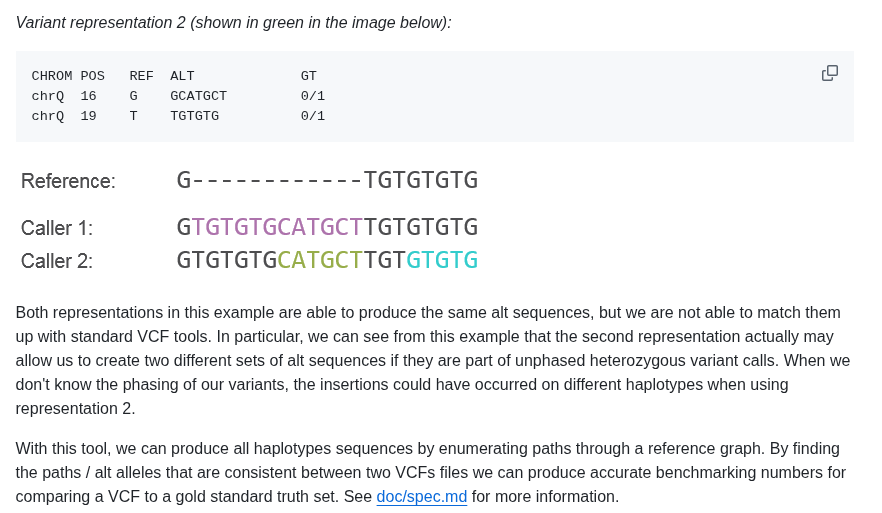
Example output table:
| Type | Filter | TRUTH.TOTAL | TRUTH.TP | TRUTH.FN | QUERY.TOTAL | QUERY.FP | QUERY.UNK | FP.gt | FP.al | METRIC.Recall | METRIC.Precision | METRIC.Frac_NA | METRIC.F1_Score | TRUTH.TOTAL.TiTv_ratio | QUERY.TOTAL.TiTv_ratio | TRUTH.TOTAL.het_hom_ratio | QUERY.TOTAL.het_hom_ratio |
|---|---|---|---|---|---|---|---|---|---|---|---|---|---|---|---|---|---|
| INDEL | ALL | 525469 | 520048 | 5421 | 908475 | 2949 | 363798 | 2010 | 455 | 0.989684 | 0.9945860000000001 | 0.400449 | 0.992129 | 1.528275734138537 | 1.9313187724266925 | ||
| INDEL | PASS | 525469 | 520048 | 5421 | 908475 | 2949 | 363798 | 2010 | 455 | 0.989684 | 0.9945860000000001 | 0.400449 | 0.992129 | 1.528275734138537 | 1.9313187724266925 | ||
| SNP | ALL | 3365127 | 3344549 | 20578 | 3841759 | 5292 | 490176 | 1401 | 562 | 0.993885 | 0.9984209999999999 | 0.127592 | 0.9961479999999999 | 2.1001284867575745 | 1.9839843850083037 | 1.5811958532541182 | 1.4858796715961773 |
| SNP | PASS | 3365127 | 3344549 | 20578 | 3841759 | 5292 | 490176 | 1401 | 562 | 0.993885 | 0.9984209999999999 | 0.127592 | 0.9961479999999999 | 2.1001284867575745 | 1.9839843850083037 | 1.5811958532541182 | 1.4858796715961773 |
- Happy outputs columns are explained by its documentation as below
Happy outputs a set of stratification columns, followed by metrics columns. Stratification columns may contain the placeholder "*" value, which indicates that counts in this row are aggregated over all possible values of the column. In case of a subtype, this means that the counts have been summed across all subtypes. In case of QQ, it means that the counts correspond to all variants rather than only ones below a QQ threshold.
| Stratification Column | Description |
|---|---|
| Type | Variant type (SNP / INDEL) |
| Subtype | Variant Subtype (ti/tv/indel length, see above |
| Subset | Subset of the genome/stratification region |
| Filter | Variant filters: PASS, SEL, ALL, or a particular filter from the query VCF |
| Genotype | Genotype of benchmarked variants (het / homalt / hetalt) |
| QQ.Field | Which field from the original VCF was used to produce QQ values in truth and query |
| QQ threshold for ROC values |
| Metric Column | Description |
|---|---|
| METRIC.Recall | Recall for truth variant representation = TRUTH.TP / (TRUTH.TP + TRUTH.FN) |
| METRIC.Precision | Precision of query variants = QUERY.TP / (QUERY.TP + QUERY.FP) |
| METRIC.Frac_NA | Fraction of non-assessed query calls = QUERY.UNK / QUERY.TOTAL |
| METRIC.F1_Score | Harmonic mean of precision and recall = 2METRIC.RecallMetric.Precision/(METRIC.Recall + METRIC.Precision) |
| TRUTH.TOTAL | Total number of truth variants |
| TRUTH.TP | Number of true-positive calls in truth representation (counted via the truth sample column) |
| TRUTH.FN | Number of false-negative calls = calls in truth without matching query call |
| QUERY.TOTAL | Total number of query calls |
| QUERY.TP | Number of true positive calls in query representation (counted via the query sample column) |
| QUERY.FP | Number of false-positive calls in the query file (mismatched query calls within the confident regions) |
| QUERY.UNK | Number of query calls outside the confident regions |
| FP.gt | Number of genotype mismatches (alleles match, but different zygosity) |
| FP.al | Number of allele mismatches (variants matched by position and not by haplotype) |
| TRUTH.TOTAL.TiTv_ratio | Transition / Transversion ratio for all truth variants |
| TRUTH.TOTAL.het_hom_ratio | Het/Hom ratio for all truth variants |
| TRUTH.FN.TiTv_ratio | Transition / Transversion ratio for false-negative variants |
| TRUTH.FN.het_hom_ratio | Het/Hom ratio for false-negative variants |
| TRUTH.TP.TiTv_ratio | Transition / Transversion ratio for true positive variants |
| TRUTH.TP.het_hom_ratio | Het/Hom ratio for true positive variants |
| QUERY.FP.TiTv_ratio | Transition / Transversion ratio for false positive variants |
| QUERY.FP.het_hom_ratio | Het/Hom ratio for false-positive variants |
| QUERY.TOTAL.TiTv_ratio | Transition / Transversion ratio for all query variants |
| QUERY.TOTAL.het_hom_ratio | Het/Hom ratio for all query variants |
| QUERY.TP.TiTv_ratio | Transition / Transversion ratio for true positive variants (query representation) |
| QUERY.TP.het_hom_ratio | Het/Hom ratio for true positive variants (query representation) |
| QUERY.UNK.TiTv_ratio | Transition / Transversion ratio for unknown variants |
| QUERY.UNK.het_hom_ratio | Het/Hom ratio for unknown variants |
| Subset.Size | When using stratification regions, this gives the number of nucleotides contained in the current subset |
| Subset.IS_CONF.Size | This gives the number of confident bases (-f regions) in the current subset |
3.3 Script And Environment Setup For Benchmarking
3.3.1 Install
#!/bin/bash
# Benchmark script for HG002 with DeepVariant, FreeBayes, HaplotypeCaller, Manta, Strelka (relative paths)
set -euo pipefail

HGREF="references/Homo_sapiens_assembly38.fasta"
REF="HG002"
BED="references/${REF}_GRCh38_1_22_v4.2.1_benchmark_noinconsistent.bed"
TRUTH="references/${REF}_GRCh38_1_22_v4.2.1_benchmark.vcf.gz"
SDF="references/grch38.sdf"
THREADS=16

RESULTSDIR="results"
mkdir -p "$RESULTSDIR"

TOOLS=(deepvariant freebayes haplotypecaller manta strelka)

VCF_DEEPVARIANT="pipelines/sarek/variant_calling/deepvariant/HG002/HG002.deepvariant.vcf.gz"
VCF_FREEBAYES="pipelines/sarek/variant_calling/freebayes/HG002/HG002.freebayes.vcf.gz"
VCF_HAPLOTYPECALLER="pipelines/sarek/variant_calling/haplotypecaller/HG002/HG002.haplotypecaller.vcf.gz"
VCF_MANTA="pipelines/sarek/variant_calling/manta/HG002/HG002.manta.diploid_sv.vcf.gz"
VCF_STRELKA="pipelines/sarek/variant_calling/strelka/HG002/HG002.strelka.variants.vcf.gz"

# Path map
declare -A VCF_PATHS=(
  [deepvariant]="$VCF_DEEPVARIANT"
  [freebayes]="$VCF_FREEBAYES"
  [haplotypecaller]="$VCF_HAPLOTYPECALLER"
  [manta]="$VCF_MANTA"
  [strelka]="$VCF_STRELKA"
)

for TOOL in "${TOOLS[@]}"; do
  TOOLDIR="$RESULTSDIR/$TOOL"
  mkdir -p "$TOOLDIR"
  VCF="${VCF_PATHS[$TOOL]}"
  LOG="$TOOLDIR/${REF}_${TOOL}.log"
  SUMMARY="$TOOLDIR/${REF}_${TOOL}.summary.csv"
  FORMATTED="$TOOLDIR/${REF}_${TOOL}.formatted.summary.csv"
  OUTPUT="$TOOLDIR/${REF}_${TOOL}"

  # If the tool output folder already exists with summary file, continue from AWK formatting (line 55)
  if [[ -f "${OUTPUT}.summary.csv" ]]; then
    echo "Output for $TOOL already exists, formatting summary."
    awk -v d="${TOOL}_${REF}" -F',' 'FNR==1{a="run"} FNR>1{a=d} {print $0",\t"a}' "${OUTPUT}.summary.csv" > "$FORMATTED"
    echo "Completed $TOOL (using existing output)"
    continue
  fi

  if [[ ! -f "$VCF" ]]; then
    echo "VCF file not found for $TOOL: $VCF" >&2
    continue
  fi

  echo "Benchmarking $TOOL for $REF ..."
  hap.py "$TRUTH" "$VCF" \
    -o "$OUTPUT" \
    -V --engine=vcfeval --threads "$THREADS" --engine-vcfeval-template "$SDF" \
    -f "$BED" \
    --logfile "$LOG" \
    --scratch-prefix .

  if [[ -f "${OUTPUT}.summary.csv" ]]; then
    awk -v d="${TOOL}_${REF}" -F',' 'FNR==1{a="run"} FNR>1{a=d} {print $0",\t"a}' "${OUTPUT}.summary.csv" > "$FORMATTED"
  else
    echo "Warning: ${OUTPUT}.summary.csv not found for $TOOL" >&2
  fi

  echo "Completed $TOOL"
done

MERGED="$RESULTSDIR/merged_${REF}_benchmark.csv"
echo "Merging summaries to $MERGED ..."
awk '(NR == 1) || (FNR > 1)' "$RESULTSDIR"/*/*.formatted.summary.csv > "$MERGED"
echo "All done. Results for $REF in $MERGED"
3.3.2 Running Benchmarking Script
Then you can obtain the result as below
├── results
│   └── sarek
│       ├── deepvariant
│       │   ├── HG002_deepvariant.extended.csv
│       │   ├── HG002_deepvariant.formatted.summary.csv
│       │   ├── HG002_deepvariant.log
│       │   ├── HG002_deepvariant.metrics.json.gz
│       │   ├── HG002_deepvariant.roc.Locations.INDEL.PASS.csv.gz
│       │   ├── HG002_deepvariant.roc.Locations.INDEL.csv.gz
│       │   ├── HG002_deepvariant.roc.Locations.SNP.PASS.csv.gz
│       │   ├── HG002_deepvariant.roc.Locations.SNP.csv.gz
│       │   ├── HG002_deepvariant.roc.all.csv.gz
│       │   ├── HG002_deepvariant.runinfo.json
│       │   ├── HG002_deepvariant.summary.csv
│       │   ├── HG002_deepvariant.vcf.gz
│       │   └── HG002_deepvariant.vcf.gz.tbi
│       ├── freebayes
│       │   ├── HG002_freebayes.extended.csv
│       │   ├── HG002_freebayes.formatted.summary.csv
│       │   ├── HG002_freebayes.log
│       │   ├── HG002_freebayes.metrics.json.gz
│       │   ├── HG002_freebayes.roc.Locations.INDEL.PASS.csv.gz
│       │   ├── HG002_freebayes.roc.Locations.INDEL.csv.gz
│       │   ├── HG002_freebayes.roc.Locations.SNP.PASS.csv.gz
│       │   ├── HG002_freebayes.roc.Locations.SNP.csv.gz
│       │   ├── HG002_freebayes.roc.all.csv.gz
│       │   ├── HG002_freebayes.runinfo.json
│       │   ├── HG002_freebayes.summary.csv
│       │   ├── HG002_freebayes.vcf.gz
│       │   └── HG002_freebayes.vcf.gz.tbi
│       ├── haplotypecaller
│       │   ├── HG002_haplotypecaller.extended.csv
│       │   ├── HG002_haplotypecaller.formatted.summary.csv
│       │   ├── HG002_haplotypecaller.log
│       │   ├── HG002_haplotypecaller.metrics.json.gz
│       │   ├── HG002_haplotypecaller.roc.Locations.INDEL.PASS.csv.gz
│       │   ├── HG002_haplotypecaller.roc.Locations.INDEL.csv.gz
│       │   ├── HG002_haplotypecaller.roc.Locations.SNP.PASS.csv.gz
│       │   ├── HG002_haplotypecaller.roc.Locations.SNP.csv.gz
│       │   ├── HG002_haplotypecaller.roc.all.csv.gz
│       │   ├── HG002_haplotypecaller.runinfo.json
│       │   ├── HG002_haplotypecaller.summary.csv
│       │   ├── HG002_haplotypecaller.vcf.gz
│       │   └── HG002_haplotypecaller.vcf.gz.tbi
│       ├── manta
│       │   ├── HG002_manta.extended.csv
│       │   ├── HG002_manta.formatted.summary.csv
│       │   ├── HG002_manta.log
│       │   ├── HG002_manta.metrics.json.gz
│       │   ├── HG002_manta.roc.Locations.INDEL.PASS.csv.gz
│       │   ├── HG002_manta.roc.Locations.INDEL.csv.gz
│       │   ├── HG002_manta.roc.Locations.SNP.PASS.csv.gz
│       │   ├── HG002_manta.roc.Locations.SNP.csv.gz
│       │   ├── HG002_manta.roc.all.csv.gz
│       │   ├── HG002_manta.runinfo.json
│       │   ├── HG002_manta.summary.csv
│       │   ├── HG002_manta.vcf.gz
│       │   └── HG002_manta.vcf.gz.tbi
│       ├── merged_HG002_benchmark.csv
│       └── strelka
│           ├── HG002_strelka.extended.csv
│           ├── HG002_strelka.formatted.summary.csv
│           ├── HG002_strelka.log
│           ├── HG002_strelka.metrics.json.gz
│           ├── HG002_strelka.roc.Locations.INDEL.PASS.csv.gz
│           ├── HG002_strelka.roc.Locations.INDEL.csv.gz
│           ├── HG002_strelka.roc.Locations.SNP.PASS.csv.gz
│           ├── HG002_strelka.roc.Locations.SNP.csv.gz
│           ├── HG002_strelka.roc.all.csv.gz
│           ├── HG002_strelka.runinfo.json
│           ├── HG002_strelka.summary.csv
│           ├── HG002_strelka.vcf.gz
│           └── HG002_strelka.vcf.gz.tbi
3.3.3 Overview From Output
I benchmarked several popular variant callers—DeepVariant, FreeBayes, HaplotypeCaller, Strelka, and Manta—on the HG002 dataset, evaluating performance separately for SNPs and INDELs using Recall, Precision, and F1-score.
Overall, DeepVariant achieved the best performance, showing the highest balance between recall and precision for both SNPs (F1 ≈ 0.996) and INDELs (F1 ≈ 0.992). HaplotypeCaller and Strelka also performed strongly, with slightly lower recall or precision depending on the variant type. FreeBayes showed comparable recall but noticeably lower precision, indicating more false positives.
SNP detection was consistently strong across most tools (recall ≈ 0.99), while INDEL calling showed more variability, highlighting the greater difficulty of detecting small insertions and deletions accurately.
As expected, Manta performed poorly for SNPs and INDELs, since it is designed primarily for structural variant detection rather than small variants.
Overall, these results confirm that modern machine-learning–based callers like DeepVariant provide the most balanced performance, while traditional callers remain competitive but may require stricter filtering to control false positives.
- modern machine-learning–based callers like DeepVariant provide the most balanced performance, while traditional callers remain competitive but may require stricter filtering to control false positives.
- It shows the consistent with old sarek version from its publication in June 2024: https://academic.oup.com/nargab/article/doi/10.1093/nargab/lqae031/7658070
See the merged_HG002_benchmark.csv is the aggregated results are showed as below
| Type | Filter | TRUTH.TOTAL | TRUTH.TP | TRUTH.FN | QUERY.TOTAL | QUERY.FP | QUERY.UNK | FP.gt | FP.al | METRIC.Recall | METRIC.Precision | METRIC.Frac_NA | METRIC.F1_Score | TRUTH.TOTAL.TiTv_ratio | QUERY.TOTAL.TiTv_ratio | TRUTH.TOTAL.het_hom_ratio | QUERY.TOTAL.het_hom_ratio | run |
|---|---|---|---|---|---|---|---|---|---|---|---|---|---|---|---|---|---|---|
| INDEL | ALL | 525469 | 520048 | 5421 | 908475 | 2949 | 363798 | 2010 | 455 | 0.989684 | 0.994586 | 0.400449 | 0.992129 | 1.528275734138537 | 1.9313187724266925 | deepvariant_HG002 | ||
| INDEL | PASS | 525469 | 520048 | 5421 | 908475 | 2949 | 363798 | 2010 | 455 | 0.989684 | 0.994586 | 0.400449 | 0.992129 | 1.528275734138537 | 1.9313187724266925 | deepvariant_HG002 | ||
| SNP | ALL | 3365127 | 3344549 | 20578 | 3841759 | 5292 | 490176 | 1401 | 562 | 0.993885 | 0.998421 | 0.127592 | 0.996148 | 2.1001284867575745 | 1.9839843850083037 | 1.5811958532541182 | 1.4858796715961773 | deepvariant_HG002 |
| SNP | PASS | 3365127 | 3344549 | 20578 | 3841759 | 5292 | 490176 | 1401 | 562 | 0.993885 | 0.998421 | 0.127592 | 0.996148 | 2.1001284867575745 | 1.9839843850083037 | 1.5811958532541182 | 1.4858796715961773 | deepvariant_HG002 |
| INDEL | ALL | 525469 | 504432 | 21037 | 881738 | 19441 | 341005 | 13873 | 1528 | 0.959965 | 0.964047 | 0.386742 | 0.962002 | 1.528275734138537 | 1.8211051374734122 | freebayes_HG002 | ||
| INDEL | PASS | 525469 | 504432 | 21037 | 881738 | 19441 | 341005 | 13873 | 1528 | 0.959965 | 0.964047 | 0.386742 | 0.962002 | 1.528275734138537 | 1.8211051374734122 | freebayes_HG002 | ||
| SNP | ALL | 3365127 | 3344473 | 20654 | 4423242 | 129028 | 946030 | 3762 | 16431 | 0.993862 | 0.962893 | 0.213877 | 0.978133 | 2.1001284867575745 | 1.8132303933942775 | 1.5811958532541182 | 1.8836484571228804 | freebayes_HG002 |
| SNP | PASS | 3365127 | 3344473 | 20654 | 4423242 | 129028 | 946030 | 3762 | 16431 | 0.993862 | 0.962893 | 0.213877 | 0.978133 | 2.1001284867575745 | 1.8132303933942775 | 1.5811958532541182 | 1.8836484571228804 | freebayes_HG002 |
| INDEL | ALL | 525469 | 516926 | 8543 | 895219 | 6343 | 351037 | 3797 | 436 | 0.983742 | 0.988344 | 0.392124 | 0.986038 | 1.528275734138537 | 1.8797119780755498 | haplotypecaller_HG002 | ||
| INDEL | PASS | 525469 | 516926 | 8543 | 895219 | 6343 | 351037 | 3797 | 436 | 0.983742 | 0.988344 | 0.392124 | 0.986038 | 1.528275734138537 | 1.8797119780755498 | haplotypecaller_HG002 | ||
| SNP | ALL | 3365127 | 3340110 | 25017 | 3957190 | 28452 | 587714 | 2758 | 2288 | 0.992566 | 0.991556 | 0.148518 | 0.992061 | 2.1001284867575745 | 1.9560158340309197 | 1.5811958532541182 | 1.7246457081290798 | haplotypecaller_HG002 |
| SNP | PASS | 3365127 | 3340110 | 25017 | 3957190 | 28452 | 587714 | 2758 | 2288 | 0.992566 | 0.991556 | 0.148518 | 0.992061 | 2.1001284867575745 | 1.9560158340309197 | 1.5811958532541182 | 1.7246457081290798 | haplotypecaller_HG002 |
| INDEL | ALL | 525469 | 8 | 525461 | 7821 | 114 | 7699 | 0 | 42 | 1.5e-05 | 0.065574 | 0.984401 | 3e-05 | 1.528275734138537 | 1.0282749675745784 | manta_HG002 | ||
| INDEL | PASS | 525469 | 8 | 525461 | 6877 | 106 | 6763 | 0 | 36 | 1.5e-05 | 0.070175 | 0.983423 | 3e-05 | 1.528275734138537 | 1.060851318944844 | manta_HG002 | ||
| SNP | ALL | 3365127 | 3 | 3365124 | 1416 | 4 | 1408 | 0 | 0 | 1e-06 | 0.5 | 0.99435 | 2e-06 | 2.1001284867575745 | 0.9005524861878453 | 1.5811958532541182 | 1.002828854314003 | manta_HG002 |
| SNP | PASS | 3365127 | 3 | 3365124 | 1230 | 4 | 1222 | 0 | 0 | 1e-06 | 0.5 | 0.993496 | 2e-06 | 2.1001284867575745 | 0.8307692307692308 | 1.5811958532541182 | 0.9967532467532467 | manta_HG002 |
| INDEL | ALL | 525469 | 515560 | 9909 | 875380 | 6569 | 334974 | 4149 | 572 | 0.981143 | 0.987844 | 0.382661 | 0.984482 | 1.528275734138537 | 1.8953993716115898 | strelka_HG002 | ||
| INDEL | PASS | 525469 | 513675 | 11794 | 834212 | 3403 | 298722 | 2401 | 324 | 0.977555 | 0.993645 | 0.358089 | 0.985535 | 1.528275734138537 | 1.8205751890885689 | strelka_HG002 | ||
| SNP | ALL | 3365127 | 3341546 | 23581 | 4233605 | 67357 | 821358 | 4302 | 7749 | 0.992993 | 0.98026 | 0.194009 | 0.986585 | 2.1001284867575745 | 1.8583435698762165 | 1.5811958532541182 | 1.8781977072413574 | strelka_HG002 |
| SNP | PASS | 3365127 | 3323449 | 41678 | 3676907 | 4389 | 345864 | 909 | 758 | 0.987615 | 0.998682 | 0.094064 | 0.993118 | 2.1001284867575745 | 2.038753419553027 | 1.5811958532541182 | 1.57305061157284 | strelka_HG002 |
Recap
- Using modern framwork is good but the more important factor is about how much your pipeline show its accuracy, reliability
- For developing the pipeline, it should be carefully reviewed and benchmarked with its own gold standard
- However, using additional steps may not improve the results while consuming more computing resources (higher running cost), next blog will coming soon
References
-
hap.py tool for benchmarking germline short-read variants
https://github.com/qbic-projects/QSARK/tree/main -
Genome in a Bottle (GIAB) program for gold standard datasets
oaicite:4
https://www.nist.gov/programs-projects/genome-bottle -
nf-germline-short-read-variant-calling https://github.com/nttg8100/nf-germline-short-read-variant-calling